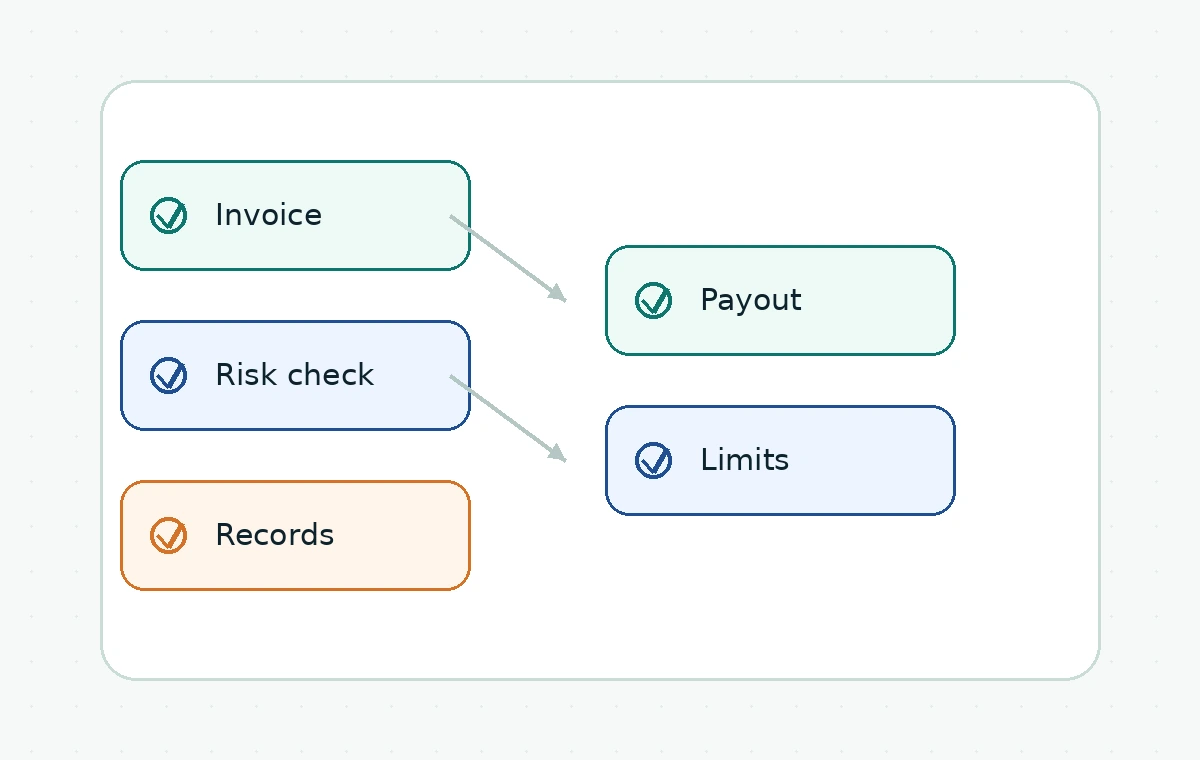
What should be ready before accepting the first payment?
Before accepting the first payment, a merchant should be able to explain the supported assets, receiving wallets, invoice expiry rules, refund workflow, transaction record format, and escalation path for suspicious or broken orders.
Launch checklist
- Choose a small set of supported assets and networks.
- Document wallet ownership, backup, and signing access.
- Set invoice expiry and exchange-rate policy.
- Define underpayment, overpayment, and refund rules.
- Record txid, asset, amount, timestamp, order ID, and USD value.
- Review sanctions and high-risk order signals.
- Test accounting export before launch.
What records should be exported?
The minimum export should connect the order ID to the transaction hash, asset, network, amount, wallet address, timestamp, fiat value, refund status, and support notes. The IRS digital assets page emphasizes recordkeeping around digital asset transactions, and OFAC virtual currency sanctions guidance explains why risk controls should not be reduced to a single checkout field.
| Field | Why it matters |
|---|---|
| Order ID | Connects payment to sale and support history |
| Transaction hash | Provides blockchain evidence |
| Asset and network | Prevents chain confusion |
| Received amount | Supports reconciliation |
| USD value | Supports tax and accounting treatment |
| Refund status | Prevents duplicate support decisions |
What should be tested before launch?
The pilot should test successful payment, expired invoice, underpayment, overpayment, unsupported network, duplicate payment, and refund request. A no-KYC checkout that cannot handle exceptions will create more friction than it removes.
Who should own the process?
Payment ownership should not sit only with marketing or only with engineering. Operations, accounting, support, and whoever manages wallets need a shared written process.
FAQ
Can the checklist be short for a small store?
Yes. Small stores can use a short checklist, but it still needs wallets, records, refunds, and escalation rules.
Should a merchant accept many assets at launch?
Usually no. A narrow asset list is easier to monitor, reconcile, and explain to customers.
Is a transaction hash enough for accounting?
No. It helps, but the merchant still needs order context and fiat valuation records.