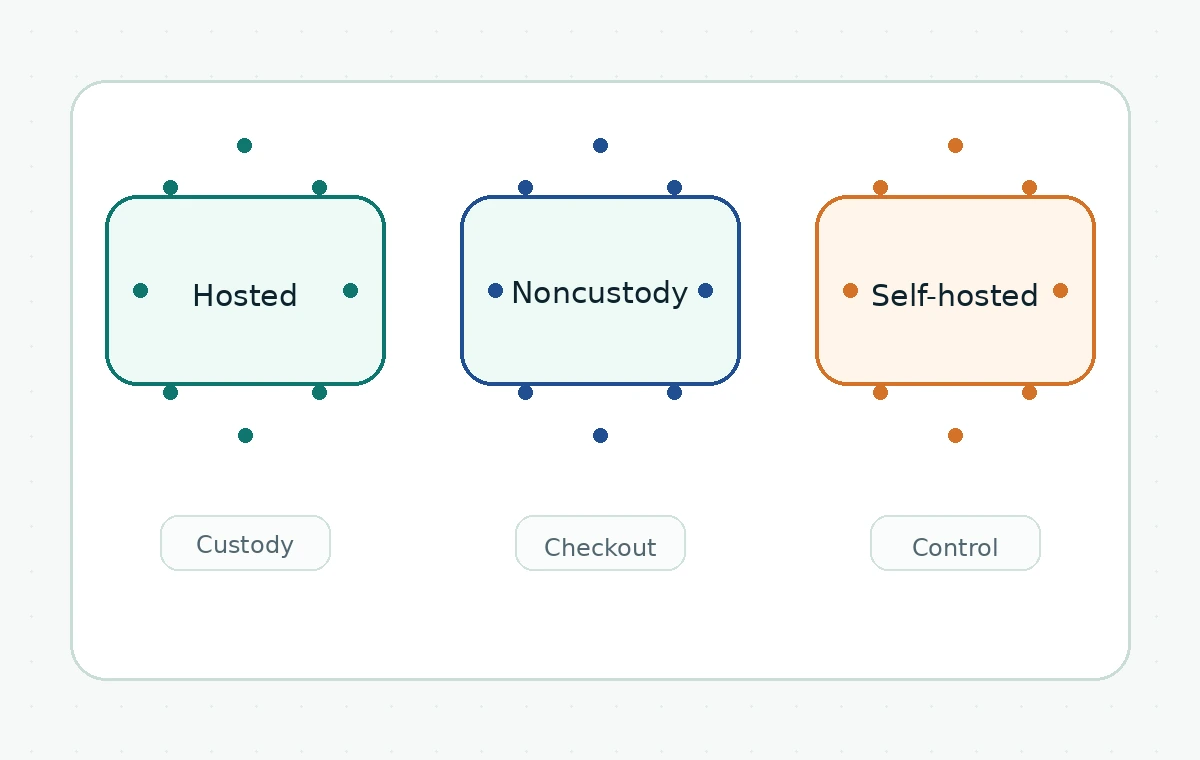
What is the central difference between gateway models?
The central difference is custody. A non-custodial gateway helps create or track a payment while funds settle to the merchant wallet. A custodial gateway receives, holds, converts, or pays out funds, which creates a different operational and compliance profile.
This distinction matters because FinCEN’s CVC guidance emphasizes facts and circumstances, not product labels. A tool called a “gateway” can be software in one setup and money movement infrastructure in another.
| Model | Central entity relation | Best fit | KYC pressure | Record burden |
|---|---|---|---|---|
| Self-hosted non-custodial | Software creates invoice; merchant receives funds | Technical merchants with wallet operations | Lower buyer KYC, merchant handles more controls | High internal records |
| Hosted non-custodial | Provider hosts checkout; merchant receives funds | Merchants needing easier setup | Moderate, policy-dependent | Shared vendor + merchant records |
| Custodial processor | Provider controls funds or payouts | Merchants needing conversion and support | Higher, especially with fiat | Provider statements + merchant reconciliation |
| Exchange-based workaround | Exchange account used as payment rail | Usually not recommended | High | Weak audit trail |
When is non-custodial better?
Non-custodial settlement is better when the merchant can operate wallets securely, reconcile transactions, explain refunds, and accept crypto exposure. It reduces counterparty custody risk, but it moves operational responsibility to the merchant.
When is custodial better?
Custodial processing is better when the merchant needs fiat payout, customer support, conversion, hosted statements, and a provider-managed operational layer. The tradeoff is verification, account controls, and dependency on processor policy.
How should a merchant decide?
A merchant should decide by mapping the payment flow: buyer sends asset, invoice expires, provider observes payment, funds settle, records export, refund path opens, and exceptions escalate. If a provider cannot explain each step, the model is not clear enough.
FAQ
Is non-custodial always safer?
No. It reduces custody risk from the provider, but it increases wallet security and reconciliation responsibility for the merchant.
Does fiat payout require more verification?
Usually yes. Fiat payout adds banking rails, which commonly creates more verification, monitoring, and payout review.
Can a hosted gateway still be non-custodial?
Yes, if the provider hosts the invoice layer but settlement goes directly to the merchant wallet.